Last night I had a dream entirely in Russian.
I am a dreamer. I mean that in the most literal sense. I have dreams every night. Vivid dreams, and more often than not, adventure dreams. I’m usually trying to accomplish some task, find some thing, help some one, achieve some goal. I often remember my dreams in great detail for the first five minutes after I wake, and then, as the sleep rubs away from my eyes, I am left only with the major points of the dream and the overall tone.
This dream involved living in a floating village which was part of a chain of villages within a complex system of fjords. I had to sail a sailboat somewhere and it was a boat that was too big for one person to sail. I remember narrowly dodging submerged boulders which were demarcated by tattered traffic cones.
The dream, like most dreams, was unimportant. The fact that the entire dream took place in Russian is what really amazes me.
I was a Comparative Literature and Russian double major in college. I went to university in Moscow for a semester and spent the following semester traveling solo through urban parts of Siberia with long visits to St. Petersburg and Moscow.
I have not spoken Russian in five years. Beloit College has a great Russian program, and compared to the other students, I was a hack. I lacked confidence and drive. But I still loved the language. I loved the structure of it, I loved the way the language was built of small blocks that allowed you to take words for complex abstract ideas and break them down in to concrete images. I loved the sound of the language, and more than anything, I loved the literature it produced. I think about returning to Russian at least once a week. But where is the time?
Even now, I sometimes flirt with the idea of becoming a Russian translator. One of the professors in my MFA, Zack Rogow, translates French poetry and when I asked him how he got into it, he said that he just started translating poems that he was curious about.
Once again, proof that all it takes to begin doing something that you want to do, is to just do it.
There are so many paths to follow.
Saturday, April 9, 2011


Wednesday, March 30, 2011
10 Years to Publish
Ten years. That’s how long it takes to publish your first novel. At least that’s what I keep hearing from people who probably know what they’re talking about (read: every professor in my MFA).
Of course, the question then becomes: from what point do you count the ten years? Do I count from the point when I first began muddling through an attempt at fiction? If so, then I’ve got one year to go (counting from that week I spent writing in Romania).
Or do I start counting from the moment of that first flash of inspiration for this particular novel?
I was in Merida, Mexico with my parents. It was fall break my senior year of college. That summer I’d begun a romance with my co-worker, Andrew, and after I’d gone back to school we’d both come to the conclusion that we were in love. He came along to Merida and, despite my parents being there, it felt like a honeymoon.
I don’t remember when the actual idea came, but I remember the first time I said it out loud. We were all sitting at tippy tables in a tiny little café on a cobble stone street. We were having flan and coffee for breakfast and a perfectly temperate breeze was rustling the napkins on the table. I told everyone that I was going to write a novel about “a man who is a bear who is a man.”
“I don’t really know what it means yet,” I said when everyone looked blankly back at me.
If so, that means I’ve got four years to go.
Or do I count from when I seriously started putting words to the page? Seriously began assembling chapters?
Seven years to go.
I like reading physical books because I can see how I’m progressing. I hold a finger on my current page, flip the book up to look at the top edge, and come up with a fraction for how far along I am: 1/5, 1/4, 1/3, 1/2, and then I stop paying attention because I’m almost finished. This helps when I get stressed out by a book. For instance, when Prince Andre “dies” for the first time in War and Peace, I was devastated until I flipped my book up and realized that there was no way Tolstoy could rob us of Prince Andre in the first quarter of the book and not bring him back to us.
So where am I? What fraction of the way am I? I’m almost through my first draft. That’s where I am. And then I’ll write a second draft. And another. And probably another.
And then I’ll write the second book that’s currently lurking on edges of my mind.
In the last two years I’ve been telling people that I’m a writer. In this last year, when I finally, truly let go of any hope of a timeline for when my novel would be finished, I actually became one.
I do want to publish. I do want to hold my book in my hands and to be able to give it as a Christmas present to every single person I know. But, I’ve got to write the damn thing first.
So. How long? It doesn’t really matter.
Of course, the question then becomes: from what point do you count the ten years? Do I count from the point when I first began muddling through an attempt at fiction? If so, then I’ve got one year to go (counting from that week I spent writing in Romania).
Or do I start counting from the moment of that first flash of inspiration for this particular novel?
I was in Merida, Mexico with my parents. It was fall break my senior year of college. That summer I’d begun a romance with my co-worker, Andrew, and after I’d gone back to school we’d both come to the conclusion that we were in love. He came along to Merida and, despite my parents being there, it felt like a honeymoon.
I don’t remember when the actual idea came, but I remember the first time I said it out loud. We were all sitting at tippy tables in a tiny little café on a cobble stone street. We were having flan and coffee for breakfast and a perfectly temperate breeze was rustling the napkins on the table. I told everyone that I was going to write a novel about “a man who is a bear who is a man.”
“I don’t really know what it means yet,” I said when everyone looked blankly back at me.
If so, that means I’ve got four years to go.
Or do I count from when I seriously started putting words to the page? Seriously began assembling chapters?
Seven years to go.
I like reading physical books because I can see how I’m progressing. I hold a finger on my current page, flip the book up to look at the top edge, and come up with a fraction for how far along I am: 1/5, 1/4, 1/3, 1/2, and then I stop paying attention because I’m almost finished. This helps when I get stressed out by a book. For instance, when Prince Andre “dies” for the first time in War and Peace, I was devastated until I flipped my book up and realized that there was no way Tolstoy could rob us of Prince Andre in the first quarter of the book and not bring him back to us.
So where am I? What fraction of the way am I? I’m almost through my first draft. That’s where I am. And then I’ll write a second draft. And another. And probably another.
And then I’ll write the second book that’s currently lurking on edges of my mind.
In the last two years I’ve been telling people that I’m a writer. In this last year, when I finally, truly let go of any hope of a timeline for when my novel would be finished, I actually became one.
I do want to publish. I do want to hold my book in my hands and to be able to give it as a Christmas present to every single person I know. But, I’ve got to write the damn thing first.
So. How long? It doesn’t really matter.
Friday, March 18, 2011
Shoot Those Pigeons Down Girl!
During the spring I shoot trap once a week with the only all women’s team at the Juneau Gun Club. There are two things that I always have to explain when I say the above sentence:
-
- Trap Shooting – Trap is a competitive clay pigeon (those orange clay discs) shooting sport. You shoot in a group of five people first at 16 yards and then at 20 yards from the pigeon house (the location where the clays are shot from). There are five shooting stations, each at slightly different angles. For each distance each person shoots a total of 25 shots. The shots are taken one at a time until each person has shot five times at the station they’re standing at, then everyone rotates. Once everyone has shot five shots at each of the five stations, the whole group moves over to the next distance.
- The Juneau Gun Club – this is a private shooting club which has a club house and the set-ups for trap. If you’re a member you can buy cheap shells, shoot, borrow guns, and drink coffee. They run the league after work during the winter, so they also run floodlights for the shooters.
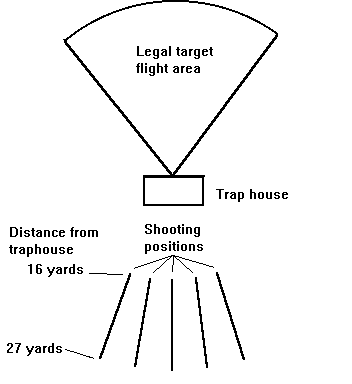 |
| A diagram of the set-up stolen from craigcolven.com |
The team I shoot with started three years ago with a group of gals who had never shot trap, and in some cases, never shot a shotgun. That’s still true this year as the team is made up of whoever we can find who might be interested. It’s a no pressure team, which is great, and I’m sure we’re the only team that shoots out there that thinks that getting one pigeon out of fifty is great.
The majority of the folks we shoot against are white, early to late middle aged men. Many of these men have special shooting jackets and shotguns that are only used for trap and cost thousands of dollars. The first year our team shot, they didn’t quite know what to do with us. Now, three years in, it feels like we’re an accepted part of the club, if a totally bizarre part. It’s probably because we giggle.
In general I shoot around 18 or 19 out of 50 pigeons. Last night I had my best night of shooting and got 26.
Trap shooting feels a lot like you’re in a live video game. When you have a great shot, the pigeon explodes in a satisfying neon orange firework, the shards dispersing over a huge patch of snow.
For our team, it’s all about personal goals. Last year my personal goal was to shoot at least one pigeon at each of the ten stations. This year my goal is to shoot at least two pigeons at each of the ten stations. I came close last night, but have not yet achieved this year’s goal.
But the result of having these goals is a complex series of mental summersaults I go through.
The interior narration:
Sweet! Got one. I love getting the first pigeon! Okay. That’s great. Pressure’s off. It would be great to get another one, but if you don’t that’s okay. You already got one. So to meet your goal all you have to do is get one more. But if you don’t, that’s okay. Okay. Stop thinking. Stop thinking. Breathe. Shoot. Dang it. That’s okay. You still have three more shots at this station. Three more chances. But if you don’t get any, it’s okay, you already got one, which is good.
 |
| The gals from the trap team who shot last night. |
And on and on.
During the league, each team has two work nights. On those nights our team doesn’t shoot, but fills up the pigeon houses when they run out of pigeons and scores other teams while they shoot. Scoring the other teams is usually a bit of a shock. They shoot so quickly! They shoot so many pigeons! The best shooters shoot 48 or 49 out of 50. It’s clear that the mental game these shooters play is very different from mine. Their expectation is that the pigeon will always explode and when it doesn’t they tighten their jaws and stare up at the night sky.
Tuesday, March 15, 2011
Self Contained and Abroad
This morning, the howl of the wind moving across the roofs of our neighborhood sounded exactly like a faint adhan, the Muslim call to prayer. With eyes closed and still on the soft edge of sleep, I woke with Turkey on the mind.
It’s hard to believe that nine years has passed since I took my first major solo trip. I was newly 19 and had settled on Eastern Europe as a good place to try: it was cheap, most of the countries were on the verge of entering the EU, it was mostly out of the major Europe travel path, and it was western enough that I wasn’t scared to go (like I was a little bit of South America and Asia).
The path:
U.K.: London
Czech Republic: Prague
Hungary: Budapest
Poland: Krakow, Oswiecim, Zakopano
Back to Hungary: Budapest
Romania: Targu Mures, Cluj-Napoca, Brasov, Sighetu Marmatiei, Bucharest
Bulgaria: Sofia, Pernik, Plovdiv
Turkey: Istanbul, Cappadocia Region
Back to Cluj Napoca, Romania
Back to Prague, Czech Republic
Back to London
Back home.
Two and a half months. A lone American woman. My first day in Prague I watched with the other hostel folks as America dropped the first bombs of the second Iraq war. That was the first moment that my trip scared me and it was the first time I ever felt the need to call myself Alaskan rather than American.
I had very little money to survive on and a strict budget. I wrote every single expense down in a small notebook, calculated my daily costs and then adjusted if needed. Some days I ate nothing but rolls with cheese from the market.
Almost everyone I met was shocked to find a nineteen year old American girl traveling by herself. This worked in my favor. Instead of being the vulnerable target that everyone thought I must be, I became the opportunity for people to do a good turn. Almost every person I met thought I needed help, I needed protecting, and as a result it was like all of my problems melted away. And I did have problems, and other scary times, but inevitably a good Samaritan would step in to help me out.
Maybe this trip is why I retain my belief in the inherent goodness of people.
It took me most of my trip to figure out that I was taking advantage of an attitude towards woman, and girls, that I had always objected to. I considered myself strong, independent, un-needy. And I was those things, but I know now that the only way I made it through those two and a half months was by allowing other people to see me the way that they wanted to and taking advantage of that attitude. I learned that there is nothing weak about accepting help when you need it.
This trip was also when I started to learn how to talk to people. I was extremely shy, nervous, and reserved around unfamiliar people. But now, traveling by myself, there were times when I thought I would go crazy if I didn’t find someone to be around and share with. At the first hostel I stayed at I watched another traveler go around and introduce himself to everyone at breakfast, ask where they were from, what they were up to, where they were going. He walked away from breakfast with two new people to spend the day exploring with, me and an Irishman.
I learned and adapted. If I hadn't opened up myself to new people, I never would've: traveled to Poland, gone to a bathhouse, gone spelunking, learned how to deal with corrupt train guards, gone to a monastery, or learned that French fries are the secret ingredient to delicious kebabs.
Turkey was the hardest place for me. Blondish, blue-eyed, big-boobed, I was a target there more than I ever had been, constantly harassed on the street. If I had gone to Turkey earlier in my trip, it would’ve been a disaster, but towards the end of my trip I had grown stronger, more willing to throw myself into uncomfortable situations and believe I could make it out the other side. Sitting in the Blue Mosque for an hour every day was my reward. Exploring the underground cities in Cappadocia, living my Indiana Jones dreams, all made it worth it.
I left Turkey and went back to Cluj-Napoca in Romania, the place I had felt the most comfortable on my trip. There, sitting at a small café, watching the tiny sparrows hop around my feet, gathering crumbs like mice, I began my first attempt at writing fiction.
Odd to know that I am that same person, even though I feel so changed.
It’s hard to believe that nine years has passed since I took my first major solo trip. I was newly 19 and had settled on Eastern Europe as a good place to try: it was cheap, most of the countries were on the verge of entering the EU, it was mostly out of the major Europe travel path, and it was western enough that I wasn’t scared to go (like I was a little bit of South America and Asia).
The path:
U.K.: London
Czech Republic: Prague
Hungary: Budapest
Poland: Krakow, Oswiecim, Zakopano
Back to Hungary: Budapest
Romania: Targu Mures, Cluj-Napoca, Brasov, Sighetu Marmatiei, Bucharest
Bulgaria: Sofia, Pernik, Plovdiv
Turkey: Istanbul, Cappadocia Region
Back to Cluj Napoca, Romania
Back to Prague, Czech Republic
Back to London
Back home.
Two and a half months. A lone American woman. My first day in Prague I watched with the other hostel folks as America dropped the first bombs of the second Iraq war. That was the first moment that my trip scared me and it was the first time I ever felt the need to call myself Alaskan rather than American.
I had very little money to survive on and a strict budget. I wrote every single expense down in a small notebook, calculated my daily costs and then adjusted if needed. Some days I ate nothing but rolls with cheese from the market.
Almost everyone I met was shocked to find a nineteen year old American girl traveling by herself. This worked in my favor. Instead of being the vulnerable target that everyone thought I must be, I became the opportunity for people to do a good turn. Almost every person I met thought I needed help, I needed protecting, and as a result it was like all of my problems melted away. And I did have problems, and other scary times, but inevitably a good Samaritan would step in to help me out.
Maybe this trip is why I retain my belief in the inherent goodness of people.
It took me most of my trip to figure out that I was taking advantage of an attitude towards woman, and girls, that I had always objected to. I considered myself strong, independent, un-needy. And I was those things, but I know now that the only way I made it through those two and a half months was by allowing other people to see me the way that they wanted to and taking advantage of that attitude. I learned that there is nothing weak about accepting help when you need it.
This trip was also when I started to learn how to talk to people. I was extremely shy, nervous, and reserved around unfamiliar people. But now, traveling by myself, there were times when I thought I would go crazy if I didn’t find someone to be around and share with. At the first hostel I stayed at I watched another traveler go around and introduce himself to everyone at breakfast, ask where they were from, what they were up to, where they were going. He walked away from breakfast with two new people to spend the day exploring with, me and an Irishman.
I learned and adapted. If I hadn't opened up myself to new people, I never would've: traveled to Poland, gone to a bathhouse, gone spelunking, learned how to deal with corrupt train guards, gone to a monastery, or learned that French fries are the secret ingredient to delicious kebabs.
Turkey was the hardest place for me. Blondish, blue-eyed, big-boobed, I was a target there more than I ever had been, constantly harassed on the street. If I had gone to Turkey earlier in my trip, it would’ve been a disaster, but towards the end of my trip I had grown stronger, more willing to throw myself into uncomfortable situations and believe I could make it out the other side. Sitting in the Blue Mosque for an hour every day was my reward. Exploring the underground cities in Cappadocia, living my Indiana Jones dreams, all made it worth it.
I left Turkey and went back to Cluj-Napoca in Romania, the place I had felt the most comfortable on my trip. There, sitting at a small café, watching the tiny sparrows hop around my feet, gathering crumbs like mice, I began my first attempt at writing fiction.
Odd to know that I am that same person, even though I feel so changed.
Tuesday, February 15, 2011
How-Things-Are-Going
At lunch with my mother this week I started off with giving her the bulleted update of how-things-are-going. I was talking for a long time, which is when I realized that my life has gotten exponentially more complicated:
The two month dry spell that I’ve written a lot about recently was also a dry spell for all of these other activities. Nothing was going on. Thinking more about it, maybe that’s part of the problem, for those two months I was freaking out so much about all of the different irons I had in the fire that I stressed myself out of doing most of them.
Weirdly enough, I think that having all of the balls in the air, is the way to keep all the balls in the air. If I lost one or two, suddenly the others would start to sag as well.
I get that this is a lot of me me me talk, but in the next couple of posts, I’m going to go through each of these foci, bust them apart, and try to produce more thoughtful writing about each.
- The writing has been going well. After two months of dithering I finally got things moving and have been writing every day for going on three weeks now. I’m pushing pushing pushing forwards and trying to accept the fact that, while I need this prose be good, it’s going to be re-written, so I also just need to get as much framing up as possible.
- Roller derby has been going well. There are now forty people in Juneau who refer to me as #574 – Hellion Hanson. My skating has been getting better, I’m constantly pushing myself to try new skills, and I’m hitting harder. I’m also now helping teach a beginning skating class through the Juneau Community Schools program. I’m feeling confident that we’ll be bout ready by the summer.
- Music has been going well. I’m up to 40 songs in my repertoire and that now includes one song in Cajun French. Andrew, our friend Sergei, and I have been getting together every other week to make dinner, talk about how awesome Cajun music is, and pretend to play a song or two. Recently our pretend playing has been sounding more and more like the real thing. On the honky tonk front, it looks like I’m playing and singing with a three gal band as the Honky-Tonk Angels for a 20 minute set in March. P.S. Singing in Cajun French is hard, especially if you don’t know any French.
- Trap shooting has been going well. Last week I had my best night of shooting yet and our team is in second place in our heat (last year we were dead last).
- Editing is going well. I’m now a member of the new editorial team for Flashquake.com, an online and print-on-demand journal dedicated to short-short fiction, non-fiction, and poetry. Reading the submissions is like getting little shots of writing energy, and trying to do a good job of responding to poetry is a new, but really exciting, challenge. We just finished our first submission deadline and our first issue goes live on March 1st.
- Work is going well.
- Andrew and I are doing well.
The two month dry spell that I’ve written a lot about recently was also a dry spell for all of these other activities. Nothing was going on. Thinking more about it, maybe that’s part of the problem, for those two months I was freaking out so much about all of the different irons I had in the fire that I stressed myself out of doing most of them.
Weirdly enough, I think that having all of the balls in the air, is the way to keep all the balls in the air. If I lost one or two, suddenly the others would start to sag as well.
I get that this is a lot of me me me talk, but in the next couple of posts, I’m going to go through each of these foci, bust them apart, and try to produce more thoughtful writing about each.
Thursday, January 27, 2011
Not Exactly Resolutions
For the last three years I’ve spent my days at a desk, on my butt, in front of a screen. My partner Andrew is a health conscious guy and the two of us have been trying to figure out a way to exercise together for all three of these years. Finally, a month ago, we broke down and joined the local gym, I switched my work schedule to 8:30 and we made our goal to be out the door by 6:30.
I’m bad at routines. Which is part of the reason I’ve never successfully had an exercise regimen and is the main reason that I’ve never followed the one piece of universal writing advice: have a writing routine. My writing, like my exercise, has been hodge-podge, wherever I can fit it in.
But last week I deviated from the new exercise routine and left the gym a little early to go sit in a café and write for forty-five minutes. For the fiftieth time, I began the same chapter I’ve been working on for the last two months and in those forty-five minutes I busted through all that self-torture and finally wrote something I liked.
I altered the exercise schedule. Now we leave a half hour earlier for our physical exercise and then I go sit in a café for forty-five minutes of writing exercise. So far, things are looking good, and now that my day starts so productively, I end up on such a high I barely need a cup of coffee!
Being the dork that I am, I googled how to establish and maintain routines. Apparently it takes about three weeks for something to officially become a part of your life to the point where you feel obligated to maintain it.
I’ve got two weeks to go, but I’m feeling confident.
I’m bad at routines. Which is part of the reason I’ve never successfully had an exercise regimen and is the main reason that I’ve never followed the one piece of universal writing advice: have a writing routine. My writing, like my exercise, has been hodge-podge, wherever I can fit it in.
But last week I deviated from the new exercise routine and left the gym a little early to go sit in a café and write for forty-five minutes. For the fiftieth time, I began the same chapter I’ve been working on for the last two months and in those forty-five minutes I busted through all that self-torture and finally wrote something I liked.
I altered the exercise schedule. Now we leave a half hour earlier for our physical exercise and then I go sit in a café for forty-five minutes of writing exercise. So far, things are looking good, and now that my day starts so productively, I end up on such a high I barely need a cup of coffee!
Being the dork that I am, I googled how to establish and maintain routines. Apparently it takes about three weeks for something to officially become a part of your life to the point where you feel obligated to maintain it.
I’ve got two weeks to go, but I’m feeling confident.
Thursday, January 20, 2011
Don't Go Towards the Dynamite
 |
| Cerro Rico in Potosi - The Rich Mountain, currently a major co-operative silver mine and once the main source of Spain's silver. |
Two pieces of advice when traveling in Bolivia:
1. If you hear a dynamite blast in the city - go the opposite direction.
2. If someone tells you that you should get out of town for a while because there will probably be riots - get out of town.
Usually I offer this advice directly after telling people that they should definitely go to Bolivia.
You’re probably wondering: how do you know what dynamite sounds like? The answer: you know as soon as you hear it.
While we were in the country the embassy advised all American citizens to leave. This may have had something to do with the fact that the president ejected the American Ambassador. Everywhere we went, and what felt like every day, we could hear people protesting. It was as if protesting were a national sport, and everyone got in on it. If buses weren’t running? It was a protest. If the store was closed? It was a strike.
If we had been aware that the country was in such flux, we probably wouldn’t have gone. Probably. But once we were there, it became a normal part of life. We kept our ears open and followed advice that was always generously given. We never once felt in danger and every person we spoke with was kind and helpful.
I would go back to Bolivia in a heartbeat. And after traveling there, I’ve begun considering traveling to many other places that I would normally shy away from. Because really, if you just stay away from the dynamite blasts and listen when people give you advice, you can probably make it through a lot of different countries.

Friday, December 31, 2010
Second Sight
I knew that my sight was not as sharp as it had been, but I put off going to the doctor for about a year. Finally a month ago I had that long dreaded appointment. The doctor confirmed that I was nearsighted and needed glasses, I had been expecting to need reading glasses as well, so her verdict was slightly more positive than I'd allowed for. I was feeling okay. Then she put drops in my eyes to dilate the irises and told me to go look at frames while the drops took effect.
And there I stood, facing walls and walls of glasses. Panic set in. I randomly put a pair on my face. All I could see was a face with glasses, I didn’t even register how the glasses looked. I picked another pair. With each pair I got more freaked out. This was going to be a permanent part of my life now. When a shop assistant came over I told her I didn’t know what I wanted and I wasn’t going to buy glasses today anyways.
Maybe I didn’t really need glasses? The doctor said I would only really have to wear them when I drove, and I don’t have a car. I was functioning fine without glasses. Maybe I could get away without them for another year. How bad was my sight anyways?
I gave in and ordered a cheap pair online.
On Wednesday my first pair of glasses arrived in the mail. We were on our way to my parents house for a delayed Christmas dinner. I unwrapped them in the car and put them on. I had been told that I would really see the difference when I looked at trees. And there it was, instead of seeing a tree as a collection of branches, I could see every twig, every twist of bark and layer of snow, slight and thick. And not just with the trees closest to me, but all of them, everything I looked at was minutely detailed, as if I were looking at an exquisite engraving or a finely detailed miniature.
“Are you going to be okay?” Andrew asked.
“Probably. But this is really freaking me out.”
I couldn’t stop staring at everything. We drove over the bridge and the guardrail, a grid of steel bars was lit up by a streetlight which threw square shadows and was lined with glistening white snow all of which stretched into the distance, swelling in its approach.
“I can’t believe that I haven’t been seeing all of this. What else have I been missing?”
I look like a different person and feel like a different person, but that detail is addictive and the act of putting on glasses, of making one simple movement which instantly brings the world into clarity, is stunning.
And there I stood, facing walls and walls of glasses. Panic set in. I randomly put a pair on my face. All I could see was a face with glasses, I didn’t even register how the glasses looked. I picked another pair. With each pair I got more freaked out. This was going to be a permanent part of my life now. When a shop assistant came over I told her I didn’t know what I wanted and I wasn’t going to buy glasses today anyways.
Maybe I didn’t really need glasses? The doctor said I would only really have to wear them when I drove, and I don’t have a car. I was functioning fine without glasses. Maybe I could get away without them for another year. How bad was my sight anyways?
I gave in and ordered a cheap pair online.
On Wednesday my first pair of glasses arrived in the mail. We were on our way to my parents house for a delayed Christmas dinner. I unwrapped them in the car and put them on. I had been told that I would really see the difference when I looked at trees. And there it was, instead of seeing a tree as a collection of branches, I could see every twig, every twist of bark and layer of snow, slight and thick. And not just with the trees closest to me, but all of them, everything I looked at was minutely detailed, as if I were looking at an exquisite engraving or a finely detailed miniature.
“Are you going to be okay?” Andrew asked.
“Probably. But this is really freaking me out.”
I couldn’t stop staring at everything. We drove over the bridge and the guardrail, a grid of steel bars was lit up by a streetlight which threw square shadows and was lined with glistening white snow all of which stretched into the distance, swelling in its approach.
“I can’t believe that I haven’t been seeing all of this. What else have I been missing?”
I look like a different person and feel like a different person, but that detail is addictive and the act of putting on glasses, of making one simple movement which instantly brings the world into clarity, is stunning.
Tuesday, December 21, 2010
Survival
The cold February water shocked the breath right out of me. It felt good, really good, my blood was pumping, I was alive and young and crazy and alive, very very alive. We hadn’t jumped in for a swim, we’d jumped in for a shock, so as soon as the shock was over, we tried to pull ourselves out.
I had been a competitive swimmer and diver, and on the first pull I hadn’t been concerned. I firmly grabbed the icy, rough wooden boards of the float deck and pulled while kicking my feet as hard as I could. I managed to get my shoulders above the deck level, but not enough of my body to belly flop and tilt my weight out. I fell back into winter ocean. Alana, the friend I had convinced to come along, fell back by my side.
I could feel the cold in my knees. My hands were turning into claws. Alana and I gasped, breathing out in plumes of white. Neither of us said anything, but I was sure that Alana’s mind was running the same paths as mine. We were going to die if we didn’t get out. How long could an unprotected body survive in the glacial waters of Southeast Alaska? How long was it? I had been told a thousand times, five minute? Ten? Twenty? It felt like we’d been in the water for an hour.
If we didn’t get out, we were going to die and the next morning our naked bodies would be found floating in the seaglass green water, bumping along the creosote soaked pilings of the dock.
We made it out.
We tugged our clothes on and ran up the ramp and back to the car. Once we were safely within the heated space, we started to laugh, and then howl, and tell each other how amazing that was, how crazy. We drove to a friend’s house where Alana told everyone gathered what crazy girls we were.
Now I think it was a small price to pay for living past 17.
I had been a competitive swimmer and diver, and on the first pull I hadn’t been concerned. I firmly grabbed the icy, rough wooden boards of the float deck and pulled while kicking my feet as hard as I could. I managed to get my shoulders above the deck level, but not enough of my body to belly flop and tilt my weight out. I fell back into winter ocean. Alana, the friend I had convinced to come along, fell back by my side.
I could feel the cold in my knees. My hands were turning into claws. Alana and I gasped, breathing out in plumes of white. Neither of us said anything, but I was sure that Alana’s mind was running the same paths as mine. We were going to die if we didn’t get out. How long could an unprotected body survive in the glacial waters of Southeast Alaska? How long was it? I had been told a thousand times, five minute? Ten? Twenty? It felt like we’d been in the water for an hour.
 |
| The view from the float. From the CBJ webiste. |
We both grabbed the slippery deck with our cramped hands and this time, instead of kicking, we scrabbled our feet along the submerged base of the dock, ignoring the mussels and barnacles that sliced into the winter soft skin. This pull had to be the pull that brought me to safety, so instead of dropping back into the water when my arms felt like they were going to give out, I clung, and pulled with my fingers, and then my elbows, and then my chest.
We made it out.
We tugged our clothes on and ran up the ramp and back to the car. Once we were safely within the heated space, we started to laugh, and then howl, and tell each other how amazing that was, how crazy. We drove to a friend’s house where Alana told everyone gathered what crazy girls we were.
It wasn’t until I took my shoes off that I noticed that my socks were glued to my feet with dried blood. I washed out the stinging cuts. At the time I moaned and groaned until the cuts were fully healed and it stopped hurting to walk.

Thursday, November 25, 2010
In Contrast - Thankful
About two weeks ago I figured out something really important about one of the characters in my novel: she had been interned in the Funter Bay Aluet internment camp. I knew that figuring this out was important for both her and me.
Of course, the problem was, I knew very little about these interment camps. I knew the basics, that they existed and that almost a thousand Aleuts were removed from their homes by the US government. Why was this done? Who went there? What were the camps like? How long were the "prisoners" held? I had no idea. And so I embarked on my very first fiction related research project.
The building I work in also houses the Alaska State Library and the state library's historical collections. So on my lunches I became a regular visitor. Did you know that if you're an Alaska resident you can make 10 free copies a day and receive three high quality digital scans of photographs a year?
But there wasn't much. The biggest thing I found was an original report typed up by one of the main organizers of the camps in which he described the conditions of the camp from the point of view of a government employee.
One thing he said, really hit home: "However, at WardCove camp being located among the tall spruce and hemlock trees with 'no air' to which they were accustomed at home with only tall grass and continuous breezes and winds, the Aleuts did express a sense of oppression and suffocation."
Reading this line during my second research lunch, I could feel things clicking. Imagining the forest of Southeast Alaska, forests that I find comforting in the way they envelope a person, to imagine coming from a land of endless expanse and openness to this? Yes. That could be horrible. Especially if you'd never been in a landscape like ours.
Then this morning I found this document in the National Archives:


 |
| Old cannery building at Funter Bay. Taken by Marjorie Menzi, 2004. |
The building I work in also houses the Alaska State Library and the state library's historical collections. So on my lunches I became a regular visitor. Did you know that if you're an Alaska resident you can make 10 free copies a day and receive three high quality digital scans of photographs a year?
 |
| Adak - Photo from nps.org |
One thing he said, really hit home: "However, at WardCove camp being located among the tall spruce and hemlock trees with 'no air' to which they were accustomed at home with only tall grass and continuous breezes and winds, the Aleuts did express a sense of oppression and suffocation."
Reading this line during my second research lunch, I could feel things clicking. Imagining the forest of Southeast Alaska, forests that I find comforting in the way they envelope a person, to imagine coming from a land of endless expanse and openness to this? Yes. That could be horrible. Especially if you'd never been in a landscape like ours.
Then this morning I found this document in the National Archives:

That first line: "We the people of this place wants a better place than this to live. This place is no place for a living creature."
This is a petition by the Aleut women interned in the Funter Bay Evacuation Camp.
When these women returned to their homes they found their buildings looted, some in ruins, and their churches in shambles. Those from Atka? Their village was burned to the ground so that the Japanese couldn't use it.
And here I am, sitting in my lovely home, drinking a lovely cup of coffee with irish cream on Thanksgiving Day trying to envision the lives of these women who had to drink impure water and watch all of their loved ones fall sick and then return to a home that was no longer home.
The contrast is almost more powerful than I can handle.
I am feeling very fortunate and thankful today.
Monday, November 15, 2010
Pomegranite, Balsamic Vinegar, and Rosemary Reduction
This was so good, I just had to type up a recipe.
Costco has had rack of lamb in lately and since we never cook lamb but always want to, we bought a rack a week and a half ago. It was so good that we ate the whole thing in one night and decided that we had to make lamb for a dinner party we hosted last night. To make it a little more special we decided to stick with a Mediterranean theme and make a pomegranate balsamic vinegar reduction for the sauce.
The sauce was out of this world. Now I want to use it on everything.
The recipe:
1 ½ cups pomegranate juice
½ cup balsamic vinegar
1 tsp sugar
½ tsp salt
3 sprigs rosemary
Bring everything to a boil and let it reduce down to half a cup. Pick out and toss the sprigs of rosemary.
It’s tart and fruity with a little sweetness and the consistency of syrup.
And a little tip: don’t lean over the pot of boiling liquid and breathe in the steam, the boiling vinegar will make you tear up like a baby. That stuff is intense!
Costco has had rack of lamb in lately and since we never cook lamb but always want to, we bought a rack a week and a half ago. It was so good that we ate the whole thing in one night and decided that we had to make lamb for a dinner party we hosted last night. To make it a little more special we decided to stick with a Mediterranean theme and make a pomegranate balsamic vinegar reduction for the sauce.
The sauce was out of this world. Now I want to use it on everything.
The recipe:
1 ½ cups pomegranate juice
½ cup balsamic vinegar
1 tsp sugar
½ tsp salt
3 sprigs rosemary
Bring everything to a boil and let it reduce down to half a cup. Pick out and toss the sprigs of rosemary.
It’s tart and fruity with a little sweetness and the consistency of syrup.
And a little tip: don’t lean over the pot of boiling liquid and breathe in the steam, the boiling vinegar will make you tear up like a baby. That stuff is intense!
Thursday, November 11, 2010
Eat Your Love
As far as I can remember, I have never eaten dirt. But reading Beth Ann Fennelly’s article for The Oxford American about the history and experience of geophagy, and Tejal Rao’s article for The Atlantic looking at the modernization and gentrification of geophagy almost make me want to.
I remember the first time I went to my ancestral family farm as an adult, the farm that my great grandfather was born on. I remember driving down the lane, seeing the farm house appear, and the feeling that this place was more mine than any other place I had ever been. This sense of belonging past memory, past generation upon generation, was new to me.
If you’re not native, the United States is a new place, and Alaska one of the newest places. The house I live in is one of the oldest in Juneau and it was built in 1920. I think few of us, especially those of us on the West Coast, have an understanding of what an ancestral place can do to your understanding of who you are.
When we arrived at the farm, we were greeted by my great Uncle Elliot. Walking around, looking at the buildings and the gardens, it was strange to think that these were the same things that my grandmother had seen when she was my age. The time between our lives had disappeared in a single moment, and just by standing on that ground I felt physically tied to every other woman ever born into my family. And this is without having ever lived there.
This great, rolling, full linkage of self and place seems to be a huge part of Southern life, especially for those rural families that have lived for generations in one place. So to read about the living practice of geophagy, and the historic record of geophagy, something about it makes sense to me. The need, the desire, to take the earth into your body, especially earth that is so tied to your identity. Beth Ann Fennelly writes “my husband tells me his relations (poor white Alabamians) ate the clay mortar grouting the stones of the hearth at the family's home, the ‘Old Place’—weakening the structure until it threatened to collapse.”
The metaphor of eating something you love so as to take that thing into you, make it an inseparable part of yourself, has stuck with me for a long time. Often this image is tied in my mind to the notion of a dangerous love; love so strong that it in the act of consuming, destroys the object of affection. Last night, in one of those bar conversations that goes all sorts of places, my friend Caleb told me that Wikipedia has a list of fetishes. I immediately made him show me on my iPhone. Towards the bottom of the list was Vorarephilia. A “sexual fetish and paraphilia where arousal occurs from the idea of being eaten or by the process of eating. The fantasy may involve the victim being swallowed alive, and may or may not include digestion. Since the fetish is hard to achieve in real life, it is more commonly enjoyed through pictures, stories, and video games.”
I feel a story coming on.
I remember the first time I went to my ancestral family farm as an adult, the farm that my great grandfather was born on. I remember driving down the lane, seeing the farm house appear, and the feeling that this place was more mine than any other place I had ever been. This sense of belonging past memory, past generation upon generation, was new to me.
If you’re not native, the United States is a new place, and Alaska one of the newest places. The house I live in is one of the oldest in Juneau and it was built in 1920. I think few of us, especially those of us on the West Coast, have an understanding of what an ancestral place can do to your understanding of who you are.
When we arrived at the farm, we were greeted by my great Uncle Elliot. Walking around, looking at the buildings and the gardens, it was strange to think that these were the same things that my grandmother had seen when she was my age. The time between our lives had disappeared in a single moment, and just by standing on that ground I felt physically tied to every other woman ever born into my family. And this is without having ever lived there.
This great, rolling, full linkage of self and place seems to be a huge part of Southern life, especially for those rural families that have lived for generations in one place. So to read about the living practice of geophagy, and the historic record of geophagy, something about it makes sense to me. The need, the desire, to take the earth into your body, especially earth that is so tied to your identity. Beth Ann Fennelly writes “my husband tells me his relations (poor white Alabamians) ate the clay mortar grouting the stones of the hearth at the family's home, the ‘Old Place’—weakening the structure until it threatened to collapse.”
The metaphor of eating something you love so as to take that thing into you, make it an inseparable part of yourself, has stuck with me for a long time. Often this image is tied in my mind to the notion of a dangerous love; love so strong that it in the act of consuming, destroys the object of affection. Last night, in one of those bar conversations that goes all sorts of places, my friend Caleb told me that Wikipedia has a list of fetishes. I immediately made him show me on my iPhone. Towards the bottom of the list was Vorarephilia. A “sexual fetish and paraphilia where arousal occurs from the idea of being eaten or by the process of eating. The fantasy may involve the victim being swallowed alive, and may or may not include digestion. Since the fetish is hard to achieve in real life, it is more commonly enjoyed through pictures, stories, and video games.”
I feel a story coming on.
Wednesday, October 27, 2010
Fact v. Fiction
“What is history? How can we ever know?” These were the only two sentences that I wrote on piece of lined notebook paper and mailed to my first college advisor in the middle of my summer internship. I wrote them when I lost faith. Shortly afterwards I abandoned my History major and decided to study Comparative Literature.
I spent my first year and a half of college at Antioch College in Yellowsprings, Ohio. My advisor and all-around hero was one of the two history professors, Bob Fogarty. From him I learned that I was a big fat sucker for anything that was written in a book. For our Introduction to History class, the theme was California. We read everything from dry history text books, to first person accounts, watched films, read novels, looked at visual art, all while trying to keep an eye out for what the heck “history” was. The point was that people, just like us students, lived in every time period, and through all of this material we could get a glimpse of what their lives had been like, but we could never KNOW. The point was that people, just like us, wrote these books and accounts. And the point was that people, just like us, are fallible, can misremember, and sometimes outright lie, all while claiming to tell the whole truth and nothing but the truth. Just because someone bothered to print it in black and white didn’t make it any more true.
The following summer I interned at the National Museum of American History in DC in the Division of Cultural History. I did odd jobs for David Shayt, one of the most outrageously wonderful people I’ve ever worked with. He brought me in to do object research for the 9/11 one year retrospective. When that finished, I wrote teeny tiny accession numbers on Julia Child’s kitchen utensils, did photographic research for a traveling exhibit on the history of the lunch pail, and organized the silly putty/crayon collection. I loved the museum. But the more I thought about it, the more it bothered me that I had been working for weeks and weeks on Julia Child’s kitchen. What was the point of that? Yeah it was fun, it would draw museum visitors in, it would educate about the cultural shift in middle class eating habits, but what the hell was it doing in The Museum of American History? What was being left out because Julia Child had taken its spot?
Why do we choose the things we choose for inclusion in our historical institutions and narratives?
I was much happier when I stopped trying to be a history student and switched over to literature. Literature, stories, myths, fiction, all felt SO much more true to me. Fiction knows it’s fiction and good fiction, great fiction, is fiction that feels true, emotionally, psychologically, and visually.
Which is maybe why I can’t seem to bring myself to care about whether or not a non-fiction book is totally factual. I don’t think any book can be totally factual, especially not one that is told by a person about their own experience. They’re all stories, stories that are constructed by people to be told to other people. What’s left out, the way things are worded and recalled, is all strung together to create a certain effect.
My senior year of college, the year I took my first writing workshop, was the year of the James Frey hoopla. Andrew and I talked about this the other night and he thinks it was a big deal because Frey had been successful and people like to get mad if someone gained their success in dishonest ways. Oprah’s outrage was shocking to me. What he wrote about may’ve not been totally true for him, but it was probably true to human experience. I just don’t get it.
 |
| Antioch's main building. |
 |
| The Smithsonian "Castle" |
Why do we choose the things we choose for inclusion in our historical institutions and narratives?
I was much happier when I stopped trying to be a history student and switched over to literature. Literature, stories, myths, fiction, all felt SO much more true to me. Fiction knows it’s fiction and good fiction, great fiction, is fiction that feels true, emotionally, psychologically, and visually.
Which is maybe why I can’t seem to bring myself to care about whether or not a non-fiction book is totally factual. I don’t think any book can be totally factual, especially not one that is told by a person about their own experience. They’re all stories, stories that are constructed by people to be told to other people. What’s left out, the way things are worded and recalled, is all strung together to create a certain effect.
My senior year of college, the year I took my first writing workshop, was the year of the James Frey hoopla. Andrew and I talked about this the other night and he thinks it was a big deal because Frey had been successful and people like to get mad if someone gained their success in dishonest ways. Oprah’s outrage was shocking to me. What he wrote about may’ve not been totally true for him, but it was probably true to human experience. I just don’t get it.
Which is probably why it’s a good thing I’m a fiction writer.
Thursday, October 14, 2010
Blogging About Twitter
Although I started my twitter account a mere four days ago, I’m already feeling like a convert.
To begin with, while I’ve been a long time fan of both blogging and facebook, I swore up and down that Twitter was: stupid, pointless, exactly like facebook, and something that I would NEVER use.
Two things made me change my mind:
So I got one.
And now, I’m a little bit obsessed with the posting format. Twitter famously only allows 140 characters in every post (which includes spaces). I knew this. What I didn’t know was that there is a countdown in the lower right-hand corner of the posting box. The numbers race down and often I’m at 60, and then 40, and then -3 characters before I even get halfway out of the gate. So then I go back and try and find places where I can condense, lose the unnecessary words. I don’t like abbreviations or internet speak (WTF, TOFL, FTW), so instead I’m playing with punctuation and word choice.
Twitter provides the perfect format for editing a sentence down to the essentials. I’m tempted to type every sentence from my novel into the twitter post box just to watch the countdown and then remove the fat. It’s like a minimalist’s dream tool. The only problem, is that a novel needs sentences longer, sometimes much longer, than 140 characters.
To begin with, while I’ve been a long time fan of both blogging and facebook, I swore up and down that Twitter was: stupid, pointless, exactly like facebook, and something that I would NEVER use.
Two things made me change my mind:
- When my Uncle Ray joined Facebook, his daughter left a note on his page that read “dad, you’re so late in the game on facebook – everyone’s on twitter now. jeeze!”
- I’m currently listening to the audiobook version of Franzen’s Freedom. There is a scene in which a college-age daughter is arguing with her father’s assistant. The assistant insists that she’s a young person and understands young people just as well, she’s 27 (my age) for god’s sake! But the daughter insists that there is a whole world of difference in her understanding of technology and the assistant’s, that the assistant didn’t grow up with cell phones and doesn’t understand that young people barely even email anymore.
So I got one.
And now, I’m a little bit obsessed with the posting format. Twitter famously only allows 140 characters in every post (which includes spaces). I knew this. What I didn’t know was that there is a countdown in the lower right-hand corner of the posting box. The numbers race down and often I’m at 60, and then 40, and then -3 characters before I even get halfway out of the gate. So then I go back and try and find places where I can condense, lose the unnecessary words. I don’t like abbreviations or internet speak (WTF, TOFL, FTW), so instead I’m playing with punctuation and word choice.
Twitter provides the perfect format for editing a sentence down to the essentials. I’m tempted to type every sentence from my novel into the twitter post box just to watch the countdown and then remove the fat. It’s like a minimalist’s dream tool. The only problem, is that a novel needs sentences longer, sometimes much longer, than 140 characters.
Monday, October 11, 2010
Getting Out of Juy Duty
Every morning a group of fire fighters, or volunteer fire fighters, (I’ve never actually read their badges) gets together at the same coffee shop I do. This morning I happened to overhear part of their conversation.
“The best way to get out of it is to say that everybody’s guilty.”
“Yeah, and the gorier you get, the better.”
“I’m living proof! It worked for me.”
I HATE hearing people talk about getting out of jury duty. Especially after I served on a jury this spring. I know that I’m a dorky rule follower, but nothing gets my civic-duty-goat like people talking about how to get out of jury duty. The jury I sat on was for a man accused of seven counts of child rape and molestation. It was one of the most emotionally brutal experiences of my life. But still. Both the victim and the defendant deserved a jury of thoughtful people, people willing to listen and do their best to find the truth of the matter. Luckily, that was the jury they got, and by the end of the week I was proud to have served with those twelve other people, and honored to have spent two days deliberating with truly caring and thoughtful people.
What is so important that this man in the coffee shop should try and weasel his way out? He’s going to miss his morning coffee with his bros? Sitting at a desk all day? He’d still get home for dinner and his TV shows.
“The best way to get out of it is to say that everybody’s guilty.”
“Yeah, and the gorier you get, the better.”
“I’m living proof! It worked for me.”
I HATE hearing people talk about getting out of jury duty. Especially after I served on a jury this spring. I know that I’m a dorky rule follower, but nothing gets my civic-duty-goat like people talking about how to get out of jury duty. The jury I sat on was for a man accused of seven counts of child rape and molestation. It was one of the most emotionally brutal experiences of my life. But still. Both the victim and the defendant deserved a jury of thoughtful people, people willing to listen and do their best to find the truth of the matter. Luckily, that was the jury they got, and by the end of the week I was proud to have served with those twelve other people, and honored to have spent two days deliberating with truly caring and thoughtful people.
What is so important that this man in the coffee shop should try and weasel his way out? He’s going to miss his morning coffee with his bros? Sitting at a desk all day? He’d still get home for dinner and his TV shows.
Wednesday, October 6, 2010
Iron Giants
On my way into work yesterday morning I spotted the Coastguard Icebreaker Healy cruising into Juneau with a tugboat escort. I really like icebreakers. Actually, I really like working boats of any kind. Seeing a working boat makes me feel like a little boy seeing a fire engine and I’m not sure why. I can’t help it. I’ll go down to the docks to get a close look, walk the length of the boat, and if they’re offering tours, I’ll go on board. I get giddy with excitement, wide-eyed with awe. It’s a mystery to me how a big piece of metal floating in water can affect me this way, but it does.
The Healy looks like an office building going for a ride in a gigantic office-building-sized red row-boat. The main structure of the Healy, the office building part, has a few sparse rows of tiny square windows. It is not a boat meant to go fast or divert air in any elegant way. Could that be why I like them so much? The lack of pretense in working boats? The Healy certainly makes no attempts to be anything other than a boat that can smash its way through ice as efficiently as possible.
Last fall I crewed a couple of ferry runs on a 140 foot WWII era landing craft called The Glacier. Our run was Juneau – Hoonah – Tennakee – Hoonah – Juneau and we carried only vehicles, no passengers. From a distance, if unloaded, The Glacier looks like an upside-down Vietnamese hat, with a sloping stern and the sharp angle of the drop bow. The bulk of the boat is deck space which we could load up with 7 cars and a back-hoe. The cabin is on the stern and contains a large kitchen, a dining area, three bunkrooms, and the wheelhouse. We were crewing in 8 hour shifts with two three person crews. Each week we alternated the shifts and the cooking duties.
I’d never been on the water at night before, and The Glacier was a dark boat. On the 11pm – 7am shift we sat in the wheel house with all of the lights out and the radar turned down low in an attempt to keep our night vision. Every hour I’d walk around to check the vehicles, make sure everything was looking good, and try and wake myself with the fresh air. The broad flat bow of The Glacier made it feel like we were a wall trying to force our way forward, so we rarely went faster than 8 knots (9.2 MPH).
On my second or third run the captain I was crewing with showed me his favorite spot on the boat. It was about four in the morning and I was having problems keeping my eyes open. He took me out the side door and around to the back of the wheelhouse. He told me to lean against the exhaust stacks. It was a cool night with the feeling of prenatal rain in the air. The water was calm and while there was a breeze, it wasn’t enough to kick up more than a light chop. Jerry went back to the wheelhouse and I stood watching the water break around us. The exhaust stack’s warm metal seeped into my back and the crisp breeze chilled my face. Along the edges of our wake phosphoresces glowed faintly, a dim answer to the pattern of moonlight streaking the mountains and water farther out.
There was a period of time that I seriously considered becoming an able bodied seaman, looked up schools, certifications, job postings. But like most of the other irons I put in the fire, that one eventually got pulled out and propped in some corner, soon forgotten. Who knows? Maybe someday.
The Healy looks like an office building going for a ride in a gigantic office-building-sized red row-boat. The main structure of the Healy, the office building part, has a few sparse rows of tiny square windows. It is not a boat meant to go fast or divert air in any elegant way. Could that be why I like them so much? The lack of pretense in working boats? The Healy certainly makes no attempts to be anything other than a boat that can smash its way through ice as efficiently as possible.
 |
| The Glacier |
I’d never been on the water at night before, and The Glacier was a dark boat. On the 11pm – 7am shift we sat in the wheel house with all of the lights out and the radar turned down low in an attempt to keep our night vision. Every hour I’d walk around to check the vehicles, make sure everything was looking good, and try and wake myself with the fresh air. The broad flat bow of The Glacier made it feel like we were a wall trying to force our way forward, so we rarely went faster than 8 knots (9.2 MPH).
On my second or third run the captain I was crewing with showed me his favorite spot on the boat. It was about four in the morning and I was having problems keeping my eyes open. He took me out the side door and around to the back of the wheelhouse. He told me to lean against the exhaust stacks. It was a cool night with the feeling of prenatal rain in the air. The water was calm and while there was a breeze, it wasn’t enough to kick up more than a light chop. Jerry went back to the wheelhouse and I stood watching the water break around us. The exhaust stack’s warm metal seeped into my back and the crisp breeze chilled my face. Along the edges of our wake phosphoresces glowed faintly, a dim answer to the pattern of moonlight streaking the mountains and water farther out.
There was a period of time that I seriously considered becoming an able bodied seaman, looked up schools, certifications, job postings. But like most of the other irons I put in the fire, that one eventually got pulled out and propped in some corner, soon forgotten. Who knows? Maybe someday.
Wednesday, September 29, 2010
Little Bodies
We lived in a one story squared off 60s style house with orange and brown scroll-patterned linoleum in the kitchen and orange and yellow shag carpeting in the rest of the house. By the time I have any memory of the house the shag carpeting was only left in one small closet, the rest replaced by a short blue sea. The linoleum, however, stayed for as long as we did.
Both the dining area and the TV room had large, floor to ceiling picture windows, walls that no bird ever saw. Every time a bird hit, we’d rush outside to see if it had survived. It was a clear sign that spring had arrived whenever we started finding a larger number of robins, rather than chickadees, lying stunned and prone in the flower beds. If the birds were alive we would pick them up carefully, tucking their scratchy little feet between our hands and then holding them up, like we were cupping water to drink. The birds’ quick hearts fluttered, their small dark eyes darting back and forth, the birds were so soft and fragile, like precious babies. We were big and clumsy and could hurt them, so we had to be extra careful to be nice, to hold them for only a few moments, to pet them softly, and ultimately to set them carefully in the hedge so that when the bird was ready, it would fly away on its own.
If the bird was dead, then it belonged to my father. We held no birdie burials at my house. Instead, dad would go back in and get a sandwich bag, wrap the bird up in its clear shroud, and deliver it to our birdie morgue: the freezer. There was nothing strange to us about the fact that there was a little pile of bird corpses in between the Eggos box and the ice trays. After my first year of college I was speaking to a friend about our college entrance essays, she had written hers about how her father stored birds in their freezer. Her father was also a biologist. Clearly though, she had been much more aware of herself than I had, because it wasn’t until she told me about her essay that I realized that maybe people would view that as strange behavior.
Not too long ago I dropped by my parents house after work.
“If you’re getting a glass of wine will you get me one? It’s in the freezer,” my mom asked. Next to the bottle of chardonnay, was a little body bag.
“Did you guys have a bird hit the window?”
“It’s one of the humming birds!” my dad said, “do you want to see it?”
“Sure.”
In their new house they also have picture windows, but these are on a second story, so the only birds that come close are those drawn in by my father’s hummingbird feeders.
“I feel a little guilty,” he said.
It was beautiful, but strange to see a hummingbird so still. My father was particularly excited that its tongue was extended out of its bill, like a stamen left after the flower petals had been stripped away. He explained to me about the coloring of the males versus the females, that this was a male.
As they feed from his feeder, they flash in the sun like gaudy living gems. Now on the dining room table it was like seeing the gimmick behind a magic trick.
Both the dining area and the TV room had large, floor to ceiling picture windows, walls that no bird ever saw. Every time a bird hit, we’d rush outside to see if it had survived. It was a clear sign that spring had arrived whenever we started finding a larger number of robins, rather than chickadees, lying stunned and prone in the flower beds. If the birds were alive we would pick them up carefully, tucking their scratchy little feet between our hands and then holding them up, like we were cupping water to drink. The birds’ quick hearts fluttered, their small dark eyes darting back and forth, the birds were so soft and fragile, like precious babies. We were big and clumsy and could hurt them, so we had to be extra careful to be nice, to hold them for only a few moments, to pet them softly, and ultimately to set them carefully in the hedge so that when the bird was ready, it would fly away on its own.
 |
| Rufous feeding |
Not too long ago I dropped by my parents house after work.
“If you’re getting a glass of wine will you get me one? It’s in the freezer,” my mom asked. Next to the bottle of chardonnay, was a little body bag.
“Did you guys have a bird hit the window?”
“It’s one of the humming birds!” my dad said, “do you want to see it?”
“Sure.”
In their new house they also have picture windows, but these are on a second story, so the only birds that come close are those drawn in by my father’s hummingbird feeders.
“I feel a little guilty,” he said.
It was beautiful, but strange to see a hummingbird so still. My father was particularly excited that its tongue was extended out of its bill, like a stamen left after the flower petals had been stripped away. He explained to me about the coloring of the males versus the females, that this was a male.
As they feed from his feeder, they flash in the sun like gaudy living gems. Now on the dining room table it was like seeing the gimmick behind a magic trick.
Monday, September 20, 2010
Guns
Yesterday I went hunting with my dad and his friend Billy. It was only a day hunt, and like the last two day hunts I’ve done with my dad, we did not shoot any deer. But this time I felt more confident. I knew what deer sign looked like and I called it out more than either my dad or Billy. At one point I even got the feeling that I was literally tracking a deer. We were following a deer trail through the dense blueberries and devil’s club and every once and a while I’d lose the faint indications, and then as if I was lead purely by some unconscious sense, I would choose a direction. And low and behold, there the tracks would be.
We pushed our way through the brush at the base of Mt. Jumbo to a bowl on the back side. In the bowl we found a large muskeg, in fall golds and reds. We had hit the trail by 0545, and after our hard work in the woods we were all ready for a nap. So we found a hillock and laid down. I curled up with my rifle by my side and my backpack under my head. I’m not a napper, but the warm fall sun did the trick and all three of us zonked out for an hour. It was strange to wake to a gun at my side.
I’m not a gun person. I own a gun, a Ruger .308 with a synthetic stock that my dad bought for me. It’s a small, light rifle, about as much as I would probably feel comfortable handling in the woods. I use it in the fall to go hunting with my dad and take it to the rifle range a couple of times before that to make sure I’m shooting okay. When he first got the gun for me, my father also bought himself a .450 handgun for bear protection. We went out to the range together and he insisted that I learn how to shoot the handgun. He wanted me to know what to do if I ever needed to use it. So I put up my hands, and aimed. But the gun was heavy, and I could feel my hands shaking.
“Don’t lean back so far,” he said, and tried to push me closer.
“I’m not!”
“You’re leaning back too far, you’ll never get a good shot.”
I clearly did not want to be anywhere near that gun. I don’t like handguns. Even though my dad bought it for bear protection, there is something just plain wrong with a handgun. It feels like an instrument only meant to hurt other people. A rifle or a shotgun is meant for hunting, yes they’re used to kill people, but that doesn’t feel like their main purpose.
This spring I was on an all women’s trap shooting team at the Juneau Gun Club. Before we started it had been about 10 years since I’d last shot a shotgun. It was fun, like a real video game, with the clay pigeons exploding midair in miniature orange fireworks. At a roller derby practice I mentioned something to Jeanne, our captain, about trap shooting and how she should do it. Jeanne is a ER nurse and was in the army before coming to Juneau. She told me that she could never think of guns involved in anything fun, that she would never be able to see a gun as anything other than how they had been used in Iraq.
 |
| 0630 in the woods. |
I’m not a gun person. I own a gun, a Ruger .308 with a synthetic stock that my dad bought for me. It’s a small, light rifle, about as much as I would probably feel comfortable handling in the woods. I use it in the fall to go hunting with my dad and take it to the rifle range a couple of times before that to make sure I’m shooting okay. When he first got the gun for me, my father also bought himself a .450 handgun for bear protection. We went out to the range together and he insisted that I learn how to shoot the handgun. He wanted me to know what to do if I ever needed to use it. So I put up my hands, and aimed. But the gun was heavy, and I could feel my hands shaking.
“Don’t lean back so far,” he said, and tried to push me closer.
“I’m not!”
“You’re leaning back too far, you’ll never get a good shot.”
I clearly did not want to be anywhere near that gun. I don’t like handguns. Even though my dad bought it for bear protection, there is something just plain wrong with a handgun. It feels like an instrument only meant to hurt other people. A rifle or a shotgun is meant for hunting, yes they’re used to kill people, but that doesn’t feel like their main purpose.
This spring I was on an all women’s trap shooting team at the Juneau Gun Club. Before we started it had been about 10 years since I’d last shot a shotgun. It was fun, like a real video game, with the clay pigeons exploding midair in miniature orange fireworks. At a roller derby practice I mentioned something to Jeanne, our captain, about trap shooting and how she should do it. Jeanne is a ER nurse and was in the army before coming to Juneau. She told me that she could never think of guns involved in anything fun, that she would never be able to see a gun as anything other than how they had been used in Iraq.
Friday, September 17, 2010
The Seed/Root
Last week my best friend from college came to visit, one Ms. Lynn J. Vollbrecht. She currently lives in Beloit, Wisconsin, the town we went to school in, 2,000 miles away from Juneau. She came back to Juneau with me the summer after we graduated and spent nine months here. Since then she’s come back to visit us each year for a week. This means that the bulk of our friendship is maintained by phone and by the letters she sends Andrew and I.
During her visit we had a couple of those conversations that people in love always seem to have, conversations about how much they love each other, what kind of love they have, how wonderful love is, and yadda yadda yadda. The kinds of conversations that make you feel like you’re going to burst from how full of affection you are. But we also spent time talking about the nature of friendship.
I’ve been thinking more about this. Not just about friendship, but the nature of human relationships on a grand scale. What is it that I value in other people, what is the seed of the belief that a person is a good person. Is it love? Humor? Thoughtfulness? Respect?
Last night, getting into bed, I figured it out.
em•pa•thy – noun
1. the intellectual identification with or vicarious experiencing of the feelings, thoughts, or attitudes of another.
2. the imaginative ascribing to an object, as a natural object or work of art, feelings or attitudes present in oneself: By means of empathy, a great painting becomes a mirror of the self.
It seems to me that there is no greater natural emotional response to the world. And how deep that response is! Even going back to our earliest days on this planet, there is no way that we could’ve survived without empathy. I’m going deer hunting this weekend and I know that all of my energy will be focused on empathizing with my prey. All my stillness and focus directed towards one purpose, the reaching out of my self towards that animal, the attempt to see the forest as a deer would, listen as a deer would, walk as a deer would.
I believe that every person’s best self evolves from the ability to empathize, and it’s not something that requires money, or education, or anything other than the desire to reach out to another person or thing.
But, the flipside, is that I find it almost impossible to understand (or empathize) with people who don’t or can’t empathize with others. That kind of existence seems like it would be very lonely, surface, and dark. And I imagine that this inability to bend, to attempt to extend yourself, must be the root of all horrors. I’ve been reading some accounts of soldiers with PTSD and part of that pain seems to come from the attempt, and failure, to suppress empathy in an environment in which to empathize means to fail at your purpose.
I believe that we all have a natural desire to empathize, and call me a hopeless optimist, but I think this is why I’ve always believed that people are naturally-deep-down good.
During her visit we had a couple of those conversations that people in love always seem to have, conversations about how much they love each other, what kind of love they have, how wonderful love is, and yadda yadda yadda. The kinds of conversations that make you feel like you’re going to burst from how full of affection you are. But we also spent time talking about the nature of friendship.
I’ve been thinking more about this. Not just about friendship, but the nature of human relationships on a grand scale. What is it that I value in other people, what is the seed of the belief that a person is a good person. Is it love? Humor? Thoughtfulness? Respect?
Last night, getting into bed, I figured it out.
em•pa•thy – noun
1. the intellectual identification with or vicarious experiencing of the feelings, thoughts, or attitudes of another.
2. the imaginative ascribing to an object, as a natural object or work of art, feelings or attitudes present in oneself: By means of empathy, a great painting becomes a mirror of the self.
It seems to me that there is no greater natural emotional response to the world. And how deep that response is! Even going back to our earliest days on this planet, there is no way that we could’ve survived without empathy. I’m going deer hunting this weekend and I know that all of my energy will be focused on empathizing with my prey. All my stillness and focus directed towards one purpose, the reaching out of my self towards that animal, the attempt to see the forest as a deer would, listen as a deer would, walk as a deer would.
I believe that every person’s best self evolves from the ability to empathize, and it’s not something that requires money, or education, or anything other than the desire to reach out to another person or thing.
But, the flipside, is that I find it almost impossible to understand (or empathize) with people who don’t or can’t empathize with others. That kind of existence seems like it would be very lonely, surface, and dark. And I imagine that this inability to bend, to attempt to extend yourself, must be the root of all horrors. I’ve been reading some accounts of soldiers with PTSD and part of that pain seems to come from the attempt, and failure, to suppress empathy in an environment in which to empathize means to fail at your purpose.
I believe that we all have a natural desire to empathize, and call me a hopeless optimist, but I think this is why I’ve always believed that people are naturally-deep-down good.
Monday, September 13, 2010
Words v. Numbers
"Additionally, a derivative may have complex aspects that require the auditor to have special knowledge to evaluate the measurement and disclosure of the derivative in conformity with generally accepted accounting principles. For example, features embedded in contracts or agreements may require separate accounting as a derivative, and complex pricing structures may increase the complexity of the assumptions used in estimating the fair value of a derivative."
A week ago I finished editing 200 pages of a manual that contained nothing but sentences similar to the above. I had two weeks to complete this project.
I spent hours and hours staring at these words. Words that were no longer words. Words that dreamt of being numbers. At least numbers have the pure pleasure of being unadulterated signifiers. There was no joy in these words, they existed only to point towards specific concepts. The sentences, paragraphs, and chapters circled around and around each idea, like sharks around a bloody hunk of meat, all purpose, all force.
My job was to make sure that the sentences and paragraphs all fit within generally accepted standards of English grammar. I dutifully marked it all up, debating each word, reading paragraphs and sentences over and over again. "Does this sentence make sense? Do these words make sense? What is it talking about? Is this a phrase that is common in auditing procedures?" Sometimes when I went over my edits with a manager she would shrug and say "nobody is going to read this. It doesn't really matter."
I've only ever had one other experience in my life when English sounded so completely foreign to me, and in that instance I was 14 and playing pool with two Scottish boys in a hostel in Northeast Scotland.
My goal this fall is to finish the novel that's been bumping around my head for the last several years. While I edited the manual at work, I spent my evenings at home on my own writing. I've always wanted to write a fairytale. So I wrote a fairytale for a chapter.
What a pleasure to write living words instead of dead signifiers.
A week ago I finished editing 200 pages of a manual that contained nothing but sentences similar to the above. I had two weeks to complete this project.
I spent hours and hours staring at these words. Words that were no longer words. Words that dreamt of being numbers. At least numbers have the pure pleasure of being unadulterated signifiers. There was no joy in these words, they existed only to point towards specific concepts. The sentences, paragraphs, and chapters circled around and around each idea, like sharks around a bloody hunk of meat, all purpose, all force.
My job was to make sure that the sentences and paragraphs all fit within generally accepted standards of English grammar. I dutifully marked it all up, debating each word, reading paragraphs and sentences over and over again. "Does this sentence make sense? Do these words make sense? What is it talking about? Is this a phrase that is common in auditing procedures?" Sometimes when I went over my edits with a manager she would shrug and say "nobody is going to read this. It doesn't really matter."
I've only ever had one other experience in my life when English sounded so completely foreign to me, and in that instance I was 14 and playing pool with two Scottish boys in a hostel in Northeast Scotland.
My goal this fall is to finish the novel that's been bumping around my head for the last several years. While I edited the manual at work, I spent my evenings at home on my own writing. I've always wanted to write a fairytale. So I wrote a fairytale for a chapter.
What a pleasure to write living words instead of dead signifiers.
Subscribe to:
Posts (Atom)